Skip to the main text

Independent service company · est. St. Augustine

Old City Cold Storage Co.

Sub-Zero refrigeration, wine storage and ice machines — St. Augustine and St. Johns County

+1 (904) 604-7755 Book online Monday – Friday, 8:00 am – 6:00 pm

built-in refrigeration

Built-in refrigerators and freezers

A cabinet that will not hold temperature, a compressor that never cycles off, frost where there should be none, or a door that no longer sits flush in its opening.

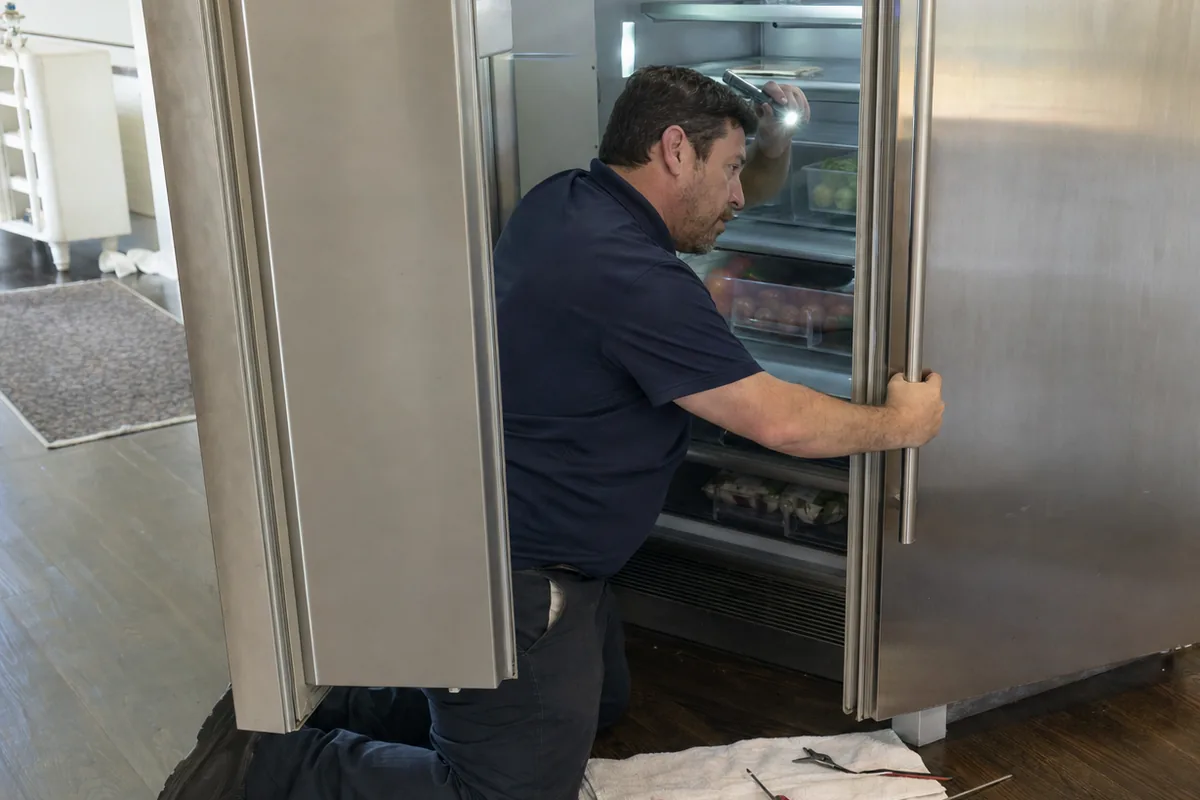
A stainless built-in refrigerator standing open in a kitchen, shelves and drawers exposed, a work towel spread on the floor
A cabinet-depth built-in, opened for diagnosis

What owners describe

  • The fresh-food side warms while the freezer stays cold
  • The compressor runs without ever cycling off
  • Frost builds on the back wall or around the vents
  • The grille blows warm and the kitchen feels it
  • Water collects under the crisper drawers
  • The door no longer sits flush or will not stay shut

A built-in Sub-Zero is not a freestanding refrigerator wearing better joinery. It is a piece of equipment fitted into the cabinetry of the room, rejecting its heat through a grille rather than into the kitchen at large, and carrying two separate sealed systems where an ordinary refrigerator carries one. That construction is much of the reason these cabinets last twenty years and more. It is also why the faults look nothing like the faults of a domestic appliance.

Two systems, two sets of symptoms

The single most useful thing an owner can tell us on the telephone is which half of the cabinet is wrong. A freezer holding hard ice while the fresh-food side drifts up into the fifties is not one machine failing by degrees; it is one of two systems down while the other carries on exactly as designed. That single observation removes a great deal of guesswork before the van has left the shop.

It also explains a complaint we hear often: the refrigerator seems to be running constantly and still is not cold. A cabinet with one system out will run the surviving system harder and longer in an attempt to make up the difference, which raises the electricity bill, warms the grille, and produces exactly the impression of an appliance labouring for no result.

What we find behind the grille

Airflow is the first thing measured on every visit, because it is the first thing to go and the cheapest thing to correct. A built-in draws air through the grille, across the condenser, and out again. Anything that narrows that path — a mat of dust and pet hair in the fins, a cabinet valance fitted years after installation, a decorative panel that never had the clearance it needed — raises head pressure. The compressor answers by running longer, the condenser fan runs longer with it, and both components age at a rate nobody intended.

Coastal houses have a second problem in the same place. Salt air reaches the 32084 and 32082 ZIP codes without much interruption, and aluminium fins do not stay bright in it. The grey film on a coastal condenser both insulates the metal and begins the slow corrosion that closes the gaps between the fins. We see the same unit, in the same model year, in a much better condition eight miles inland.

Doors, gaskets and the humidity question

St. Johns County is humid for most of the year, and a built-in door is heavy — heavier still when it carries a custom panel. Two things follow. The first is that hinges and closers wear, and a door that no longer pulls itself the last half-inch will leave a gap you cannot see but the cabinet certainly can. The second is that the magnetic gasket takes on a set. Warm, wet room air is drawn across a cold seal all summer, condensation forms, and the evaporator answers with frost in places frost has no business being.

A gasket that has gone hard, a hinge that has dropped, and a cabinet that is slightly out of square in its opening all produce the same complaint. Only one of them is a part; the other two are adjustment. We would rather adjust.

Sealed-system work and what it requires

When the fault is genuinely in the refrigerant circuit — a restriction, a leak, a compressor that will not start against pressure — the work is carried out by EPA Section 608 certified technicians, because handling refrigerant lawfully requires it. That is the one credential this shop states, and it is genuinely held. We are an independent shop and hold no appointment from the manufacturer.

What a visit costs

The visit is a flat $80 diagnostic, credited against the repair when you approve the work. You see a written estimate before any part is ordered, parts are genuine OEM, and completed repairs carry 90 days on labour and 365 days on parts. We work Monday to Friday, 8:00 am to 6:00 pm, and Saturday from 9:00 am to 4:00 pm.

We accept work on Sub-Zero refrigeration and on nothing else. If the appliance in your kitchen carries another maker’s badge, we are the wrong shop, and we will say so on the telephone rather than after the drive.

What does this work usually cost?

Once the fault has been found, this is what the work on this family of appliance usually runs to. Where a repair will fall outside these spans, you are told before any part is ordered.

$80 Flat $80 diagnostic covering the visit and the full diagnostic sequence, credited toward the repair once you approve the work.

Typical completed repairs on this work — ranges, not quotes
The work Usual completed repair
Evaporator or condenser fan motor $260–$570
Compressor or sealed-system repair $920–$2,420
Door gasket or seal replacement $240–$640
Defrost heater, thermostat or sensor $250–$600
Diagnostic visit $80, credited to the repair

A span is what an honest shop can publish before it has seen the cabinet. Parts and labour are itemised on a written estimate, the estimate is presented before anything is ordered, and the $80 figure comes off the invoice once you approve the work. Where the fault turns out to sit outside these bands, you are told before, not after.

What do owners ask about built-in refrigeration?

Why is the fresh-food side warm while the freezer stays cold?

Because a built-in carries two sealed systems rather than one. A freezer holding hard ice while the fresh-food side drifts into the fifties is one system down and one working exactly as designed. Saying which half is wrong on the telephone removes a great deal of guesswork before the van leaves.

What does a door gasket or seal repair usually cost?

A completed gasket or seal replacement usually lands in the $240–$640 band, parts and labour together, with the $80 diagnostic credited back once you approve the work. A hinge that has dropped is adjustment rather than a part, and we would rather adjust than sell you one.

It runs but does not cool. What does that usually cost?

It depends which of three things is true, and they are far apart. A blocked condenser or a stalled fan is the $260–$570 band; a defrost fault is the $250–$600 band; a sealed system genuinely down is the $920–$2,420 band. Measurement decides which, and the $80 diagnostic is what buys the measurement.

Is frost on the back wall a sealed-system fault?

Usually not. Warm, wet room air drawn past a seal that has taken a set condenses and freezes where frost has no business being, so the cabinet is answering a door fault. Airflow, frost pattern and run time are all measured before anybody discusses refrigerant.

After a built-in refrigeration visit

4.8 out of 5, across 60 customer reviews. Each entry below is one visit, described by the person whose kitchen it was.

  • The cabinet had started cycling almost without a break. He measured what the compressor was drawing, then found the condenser packed solid with dust left behind by a remodel.

    Dorian M.2026-08-25

  • The cabinet in our beach house had a hum you could hear from the hallway. A cracked fan blade was clipping its shroud. He swapped the blade, checked the balance, and the noise disappeared entirely.

    Cecily R.2026-07-21

  • Ice kept building up behind the vegetable bins. The culprit was a torn seal on the hinge side letting humid air in all day. New seal fitted, and the bins have stayed dry right through a summer.

    Dominic P.2026-07-07

All 60 of them, in full

Booking this work

$80 flat diagnostic, credited against the repair. A written estimate is presented before any part is ordered or any repair begins. 90 days on labour, 365 days on parts, on every completed repair.

Call +1 (904) 604-7755 Book a visit

Sub-Zero refrigeration only. We do not accept work on other makes.

The charges · Repair or replace · The guarantee · Questions