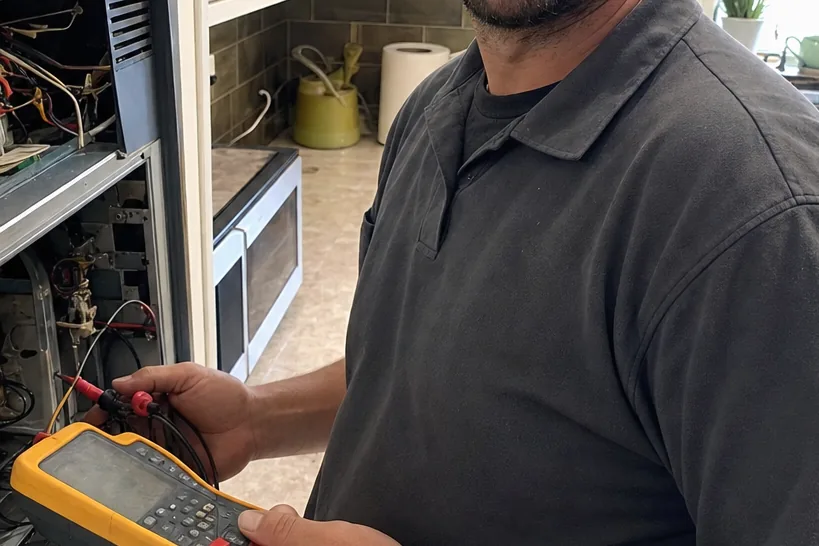
Palencia sits north of St. Augustine on the 32095 side of the county, between US 1 and the Tolomato marsh. It has been building in phases for about two decades, and that single fact shapes almost everything we do here. The kitchens are new enough that the refrigeration was specified into the cabinetry rather than squeezed in afterwards, and the earliest of them are now old enough that the first generation of appliances has reached the age where hinges, gaskets, condensers and control boards all start asking for attention at once.
A matched pair is two separate machines
The common arrangement in these kitchens is a refrigerator column standing beside a freezer column behind matched panels. Owners reasonably describe that as one appliance. It is not. Two columns are two cabinets, two sealed systems, two control boards, two evaporators and two sets of hinges that happen to share a face.
It matters for the estimate as much as for the diagnosis. When the freezer column drifts and the refrigerator beside it holds perfectly, nothing is wrong with “the refrigerator”, and the repair is confined to one machine. The same logic applies inside a single dual-refrigeration cabinet: one sealed system for the fresh-food side, another for the freezer, each able to fail while its neighbour carries on exactly as designed. Telling us which half is wrong on the telephone removes an entire class of causes before anyone opens a panel.
What twenty years of building puts in a condenser
A built-in rejects its heat through a grille rather than into the room, and fine dust from active construction does not respect a property line. We find condensers here matted an inch behind a grille that looks perfectly clean from the front. Nothing about that produces a symptom anyone would call a fault: the compressor simply runs longer every year, head pressure climbs, and the first thing the household notices is soft ice cream.
The other recurring finding is a clearance that was correct at handover and lost later — a valance fitted during a remodel, a panel added to match new cabinetry, a basket stored on top of a unit. We measure the air path before we suspect the sealed system, because the cheap explanation is far more often the true one.
When the unit has to come out
Some repairs cannot be done from the front. A built-in is anchored to the cabinetry at the top and stands on levelling feet or rollers at the rear, and bringing one out means releasing the anchors, disconnecting the water line and the supply, protecting the floor, and walking a very heavy cabinet clear of an opening it fits with little room to spare. In a Palencia kitchen with stone floors and a tight island run, that is a planned operation, not something to discover halfway through an appointment.
We would rather know before the visit whether the appliance can be pulled, where the shut-off is, and whether the panels come off. It changes the length of the appointment and, occasionally, whether the work can be finished the same day.
The salt question, answered honestly
Palencia is close enough to the Intracoastal that owners often ask about salt air. We treat 32084 and 32082 as the coastal ZIP codes where corrosion on condenser fins, hinges and stainless is a routine finding. 32095 is not on that list. It sits behind enough land that we do not see the fin corrosion here that we see on Anastasia Island, and we are not going to invent an exposure in order to sell a cleaning.
Parts, serial numbers and waiting
A great deal of what goes into a built-in is specific to a production run rather than to a model name. Gasket profiles, hinge hardware, evaporator assemblies and control boards all changed across the years these houses were built, so we take the serial number from the rating plate before anything is ordered. A part identified from a photograph of the front of the appliance is a part that comes back a second time.
Some of those components are stocked and arrive quickly. Others are ordered in, and the honest answer is that a written estimate includes the wait as well as the price. Where the sensible answer is that a twenty-year-old cabinet is worth one more repair — or that it is not — we say which, and why.
The drive, and booking in 32095
Palencia is a short run north from the shop’s centre of gravity in St. Augustine, which is why weekday morning appointments here are usually easy to place. Weekdays 8:00 am to 6:00 pm, Saturday 9:00 am to 4:00 pm.
The visit is a flat $80 diagnostic, credited against the repair when you approve it, and you see a written estimate before a part is ordered. We work on Sub-Zero refrigeration, wine storage and ice machines, and on nothing else.