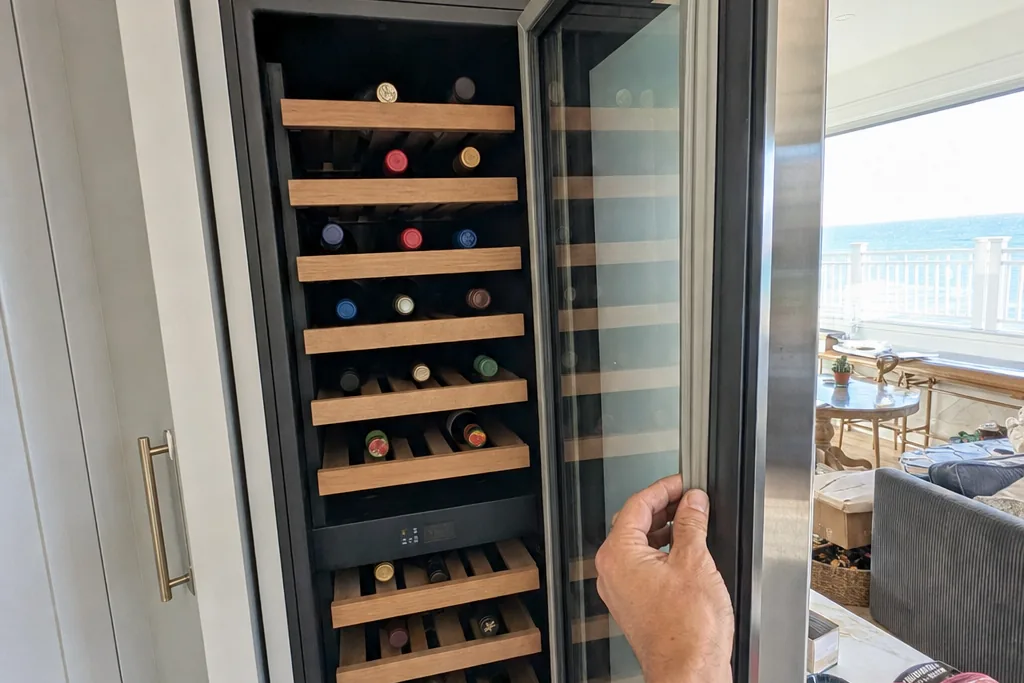
A wine cabinet is not asked to be cold. It is asked to be steady. A refrigerator that swings four degrees between cycles is behaving normally; a wine cabinet that does the same thing is failing at the only job it has, and it will do so quietly for a year before anyone opens a bottle and notices.
That difference governs how these units are diagnosed. We are not looking for a cabinet that has stopped cooling. We are looking for one that no longer holds.
Zones drift before they fail
Most of the wine storage in this county is dual zone: an upper compartment set for whites and a lower one set warmer for reds, or the reverse, depending on the household. The two zones are controlled separately, and it is entirely normal for one to be perfect while the other has walked several degrees away from its setting.
The owner’s usual report is that the cabinet “runs warm”. What we find, more often than not, is that a damper or an evaporator fan serving one zone is not doing its share, and the other zone is masking it by keeping the average respectable. Measuring both zones over a full cycle — not once, with the door open — is the difference between fixing the fault and replacing a control that was never wrong.
Humidity, and why St. Augustine is an odd case
A wine cabinet wants a middling humidity: dry enough that labels and racking do not suffer, damp enough that corks stay swollen. In most of the country the problem is that the interior gets too dry. Here, the ambient is doing the opposite. Coastal St. Johns County is humid nine months of the year, and every time the door opens, that room air arrives inside the cabinet and condenses on the coldest surface it can find.
The result is water on the inside of the glass, damp label edges on the top rows, and, in a cabinet that has been sealing poorly for a while, a musty smell that no amount of cleaning will settle until the seal is corrected. If your cabinet stands in a butler’s pantry that is not on the house air conditioning, that condition is worse again, and it is worth telling us when you book.
The glass door does more than look good
The door on a wine cabinet is a piece of thermal engineering. It is glazed for insulation, treated to keep ultraviolet light off the bottles, and sealed by a gasket that has to cope with a heavy, mostly rigid door. When the gasket takes a set, or the door drops on its hinge, the cabinet does not stop working — it starts working continuously, which is both an energy problem and a vibration problem for the bottles inside.
Vibration is the failure mode owners think about least. A compressor that runs without cycling transmits far more of it into the racking than one that runs a third of the hour. Restoring the seal restores the duty cycle, and the racking goes quiet again.
Racking, lighting and the things that are not refrigeration
Not every fault is thermal. Shelf runners bind, display lighting fails, and the control panel behind the door takes the same summer humidity as everything else. These are usually straightforward, and we would rather tell you a repair is small than dress it up.
Booking
The visit is a flat $80 diagnostic, credited against the repair when you approve the work, with a written estimate before any part is ordered. Genuine OEM parts. Completed repairs carry 90 days on labour and 365 days on parts. Weekdays 8:00 am to 6:00 pm, Saturday 9:00 am to 4:00 pm.
Old City Cold Storage Co. is independent. We service Sub-Zero wine storage and Sub-Zero refrigeration, and no other make.