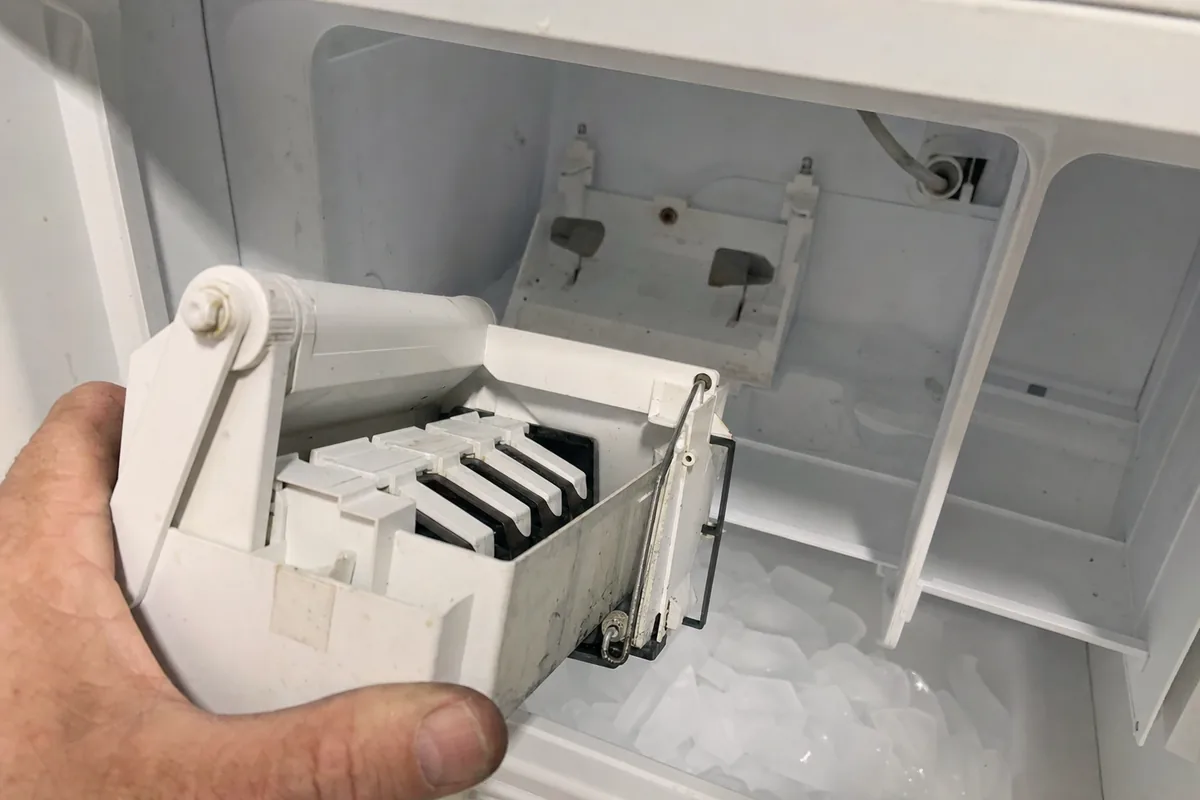
An ice machine runs a repeatable sequence: it fills a mould with a measured amount of water, freezes it, warms the mould just enough to release the ice, and drains what it does not use. Four steps, in order, on a timer. Nearly every complaint we are called about belongs to exactly one of them, which is why this is one of the most satisfying appliances in the house to diagnose properly and one of the easiest to guess wrong.
Fill: where thin cubes begin
The fill valve admits a measured slug of water into the mould on every cycle. The measure is a function of time and of orifice size, and the machine has no way of knowing that less water arrived than it expected. A partly closed shut-off behind the cabinet, a kinked supply line, a filter left in place for years or a valve that is not opening fully all produce the same result: a mould short of water, and cubes that come out thin, hollow or half formed.
Owners very reasonably read that as a freezing problem and turn the control colder. The cabinet obliges, the cube freezes harder, the harvest takes longer, and the machine produces even less than it did before. It is one of the few faults on this site where the intuitive correction makes the symptom worse.
Freeze and harvest: the mould, and the film on it
Harvest is the moment the ice lets go. A small heater warms the mould just enough to release the cube, and the whole cycle is timed around how long that should take. Anything that comes between the heater and the ice stretches that step. The machine spends more of the day running to produce a fraction of what it should, and the compressor and the harvest heater both age faster for it.
Mineral in the supply is a genuine factor in this county, and an ice maker is where it shows first: deposits narrow the fill orifice and leave a film on the mould, so each fill is a little short and each harvest a little slow. That is the argument for descaling on a schedule rather than waiting for a complaint. It is maintenance rather than a repair, and we quote it as maintenance.
A slow freeze, on the other hand, is usually not a freeze problem at all. It is heat rejection: a blocked grille, a matted condenser, or an undercounter machine whose toe-kick vent has been closed off by a later plinth or a run of new flooring. An ice machine works harder for its output than anything else in the kitchen, and it is the first appliance to complain when its air path narrows.
Drain: the third of the three
A gravity drain that has silted up backs water into the bin, where it refreezes as a sheet and takes the chute — or, in a bin machine, the auger — with it. Water standing under the unit is the outdoor version of the same story, and on a lanai installation it will also find the cabinetry.
Drain faults are also where taste complaints originate. Ice that tastes of the drain rather than of the water is telling you that the trap or the line is not clearing, and that is a cleaning and plumbing job rather than a refrigeration one.
What we measure on the visit
We run the machine through a complete cycle rather than working from the symptom, and we work outward from the cheap causes: air path first, then fill volume across a full cycle, then harvest time taken with a watch rather than estimated, then the drain and the bin. Valve and mould condition, the state of the supply line and any filter housing on it, and the shut-off itself all get looked at on the way through.
Any of these faults can be made to look like a failing sealed system if the diagnosis starts at the expensive end and works backwards. Starting at the cheap end takes about the same twenty minutes and is right far more often.
Parts, and the honest limit
Much of what goes into these machines is specific to a production run rather than to a model name, so we take the serial number from the rating plate before anything is ordered; a part identified from a photograph of the front comes back a second time. Some components are stocked and arrive quickly, others are ordered in, and the estimate names the wait as well as the price.
Where the honest answer is that the machine needs a clean, a descale and a filter rather than parts, that is the answer you get. Where a failed auger assembly and a tired sealed system arrive in the same visit — or an outdoor unit has simply spent too long in salt air — we will say that it is a replacement conversation rather than sell you the first of three repairs.
Booking
The visit is a flat $80 diagnostic, credited against the repair when you approve the work. Genuine OEM parts. 90 days on labour, 365 days on parts. Weekdays 8:00 am to 6:00 pm and Saturday 9:00 am to 4:00 pm.
Old City Cold Storage Co. is an independent repair shop working on Sub-Zero refrigeration, wine storage and ice machines throughout St. Johns County. We hold no appointment from the manufacturer and we do not accept work on other makes.