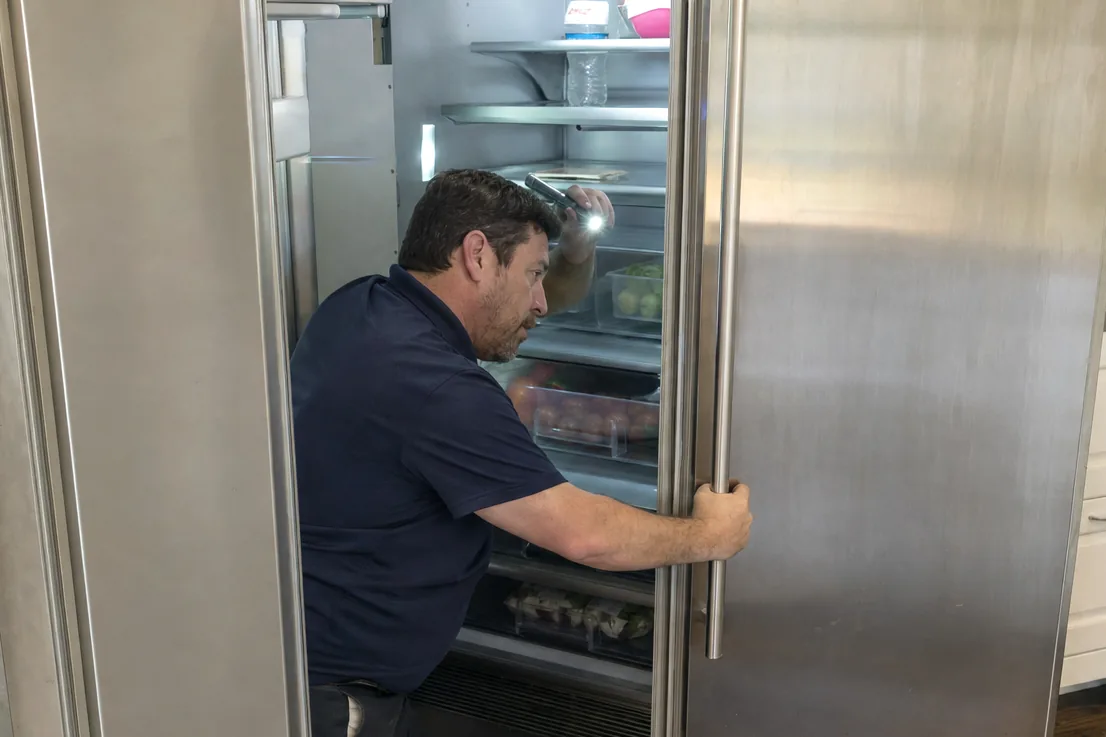
An ordinary domestic refrigerator has one refrigeration system and divides its cold between two compartments. A dual refrigeration built-in does not. It runs two separate sealed systems — each with its own compressor, its own evaporator and its own air path — so that the freezer can be kept dry and hard while the fresh-food side is kept cooler and damper than a shared system could manage.
That is a design decision about food, not about redundancy. But it has a consequence for repair that is worth understanding before you pick up the telephone.
One machine can be broken while the other is perfect
When two systems are independent, they fail independently. A freezer holding hard ice while the fresh-food compartment drifts into the fifties is not one appliance failing by degrees. It is one system down and one carrying on exactly as designed.
This is the opposite of the intuition most people bring to it. The natural reading of a warm refrigerator with a cold freezer is that the appliance is “going”, and that a replacement conversation is coming. In a dual system it frequently means the reverse: half the machine is demonstrably healthy, and the repair is confined to the other half.
Why it makes the diagnosis cheaper
A symptom confined to one compartment eliminates a whole class of causes at no cost. It cannot be the electrical supply, because that feeds both. It cannot be the room, the ambient temperature or a blocked grille shared by both systems. It cannot be the household’s habits with the doors, unless only one door is involved. Everything that would affect both is off the table before anyone opens a panel.
What is left is short: the sealed system serving that compartment, the evaporator fan for it, its defrost provision, or the control output that operates them. Four candidates instead of twenty, and all four can be separated by measurement rather than by substitution.
The other side of the coin
Two systems means two of everything to maintain, and it means an appliance can be running with half its capacity gone for a long time before anybody complains. A household that keeps very little in the freezer may not notice for months that the freezer system has stopped and the cabinet is being held cool by heat leakage alone.
The reading that catches this is the same one worth taking for any built-in: does the compressor cycle off? On a dual system, listen for two events rather than one. If the appliance now runs with a single continuous note where it used to have two distinct sounds coming and going, something has changed.
What we would like you to tell us
Three sentences make an enormous difference to the first visit:
Which compartment is wrong, and which is normal. What the temperatures actually read, if the cabinet displays them. And when it changed — a fault that appeared over one night behaves very differently from one that crept in across a summer.
With those three, the diagnostic time is spent proving a hypothesis instead of forming one, and you get a written estimate at the end of a single visit far more often than not. The visit is a flat $80 either way, credited toward the repair when you approve it.
A note on what this does not tell you
Not every warm compartment is a sealed-system fault, and a great many are not. Frost across an evaporator, a fan that has stopped, a door that no longer pulls itself the last half-inch closed, and a control board with one damaged output all produce a warm compartment while the sealed system underneath is in perfect health. The point of knowing which half is wrong is not that it names the part. It is that it halves the search before we arrive.