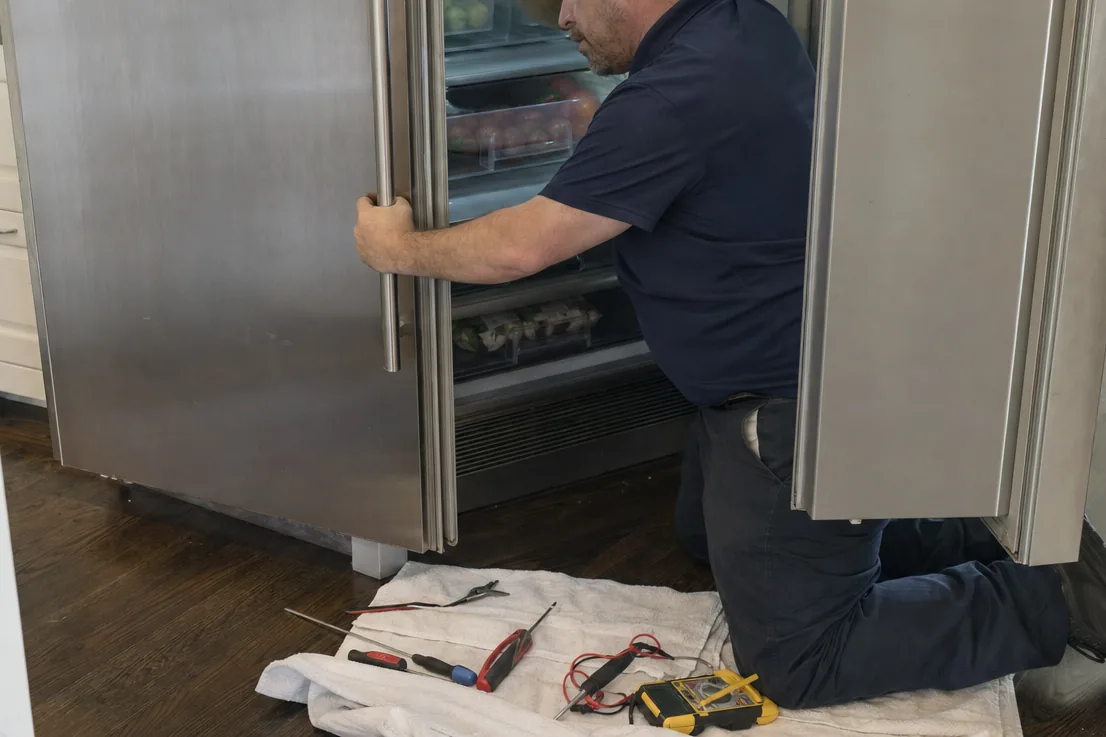
St. Johns County sees something on the order of sixty-eight thunderstorm days in a year. That is a plain climatological figure and it needs no dressing up: it simply means the electronics in these kitchens experience more surge events than the same electronics would in a drier part of the country.
Most surges do nothing. A few destroy a board outright, and the appliance is dead in a way nobody can misinterpret. The interesting case — and by a wide margin the most misdiagnosed one — is in between.
The partial failure
A refrigeration control board does several jobs at once. It reads temperature, it decides when to run a compressor, it operates a condenser fan and an evaporator fan, it manages defrost, and it drives a display and interior lighting. Those functions run through different circuits on the same board.
A surge that damages one of them leaves everything else working. The display lights. The temperature setting can be changed. The compressor starts on demand. And yet the cabinet will not hold, the grille is hot, and the compressor never cycles off.
That presentation — runs constantly, will not get cold, grille hot — is the textbook description of a failing sealed system, which is the most expensive repair on the appliance. It is also the textbook description of a condenser fan that is not turning because the output driving it has been damaged. Nothing on the front of the appliance distinguishes the two.
How it is separated
By measurement, in about twenty minutes, and in a specific order.
First, is the condenser fan turning at all, and is it turning at speed? A fan that is stalled or slow is the answer far more often than it deserves to be.
Second, if it is not turning, is voltage present at it? A fan that is receiving what it should and refusing to spin is a fan. A fan that is receiving nothing is a wiring or a board fault, and the repair is an entirely different figure.
Third, the frost pattern across the evaporator, and the run time across a complete cycle. A genuine sealed-system restriction leaves a signature there that an electrical fault does not.
None of this is exotic. It is simply the difference between diagnosing and guessing, and it is the reason we charge a flat diagnostic fee rather than quoting a repair over the telephone.
What a household can reasonably do
Surge protection at the appliance is worth having, and it is worth having on a built-in specifically, because the cost of a board here is not the cost of a board in a toaster. It will not stop a direct strike and nobody should sell it as though it will, but it addresses the far commoner case: the smaller transients that come with a storm passing over, several dozen times a year.
The other useful habit costs nothing. After a storm that has taken the power out, look at the appliance rather than assuming it came back correctly. Confirm that the display shows the setting you expect, that the cabinet is falling back to temperature over the next few hours, and that the compressor cycles off at some point in the evening. An appliance that came back “mostly” is exactly the one that will be discovered three weeks later with a freezer full of ruined food.
Older services, in the older ZIP codes
In 32084 the electrical service in many houses is old, and the earth path a surge would prefer is not always the one an engineer would choose. We find more partial board damage in the downtown houses than anywhere else on our map, and more of the related fault as well: an appliance sharing a circuit with something that draws heavily, so that the compressor is asked to start against a sagging voltage several times a day.
Neither of those is an appliance repair. Both belong in the written estimate, because a repair carried out on top of them will not last.