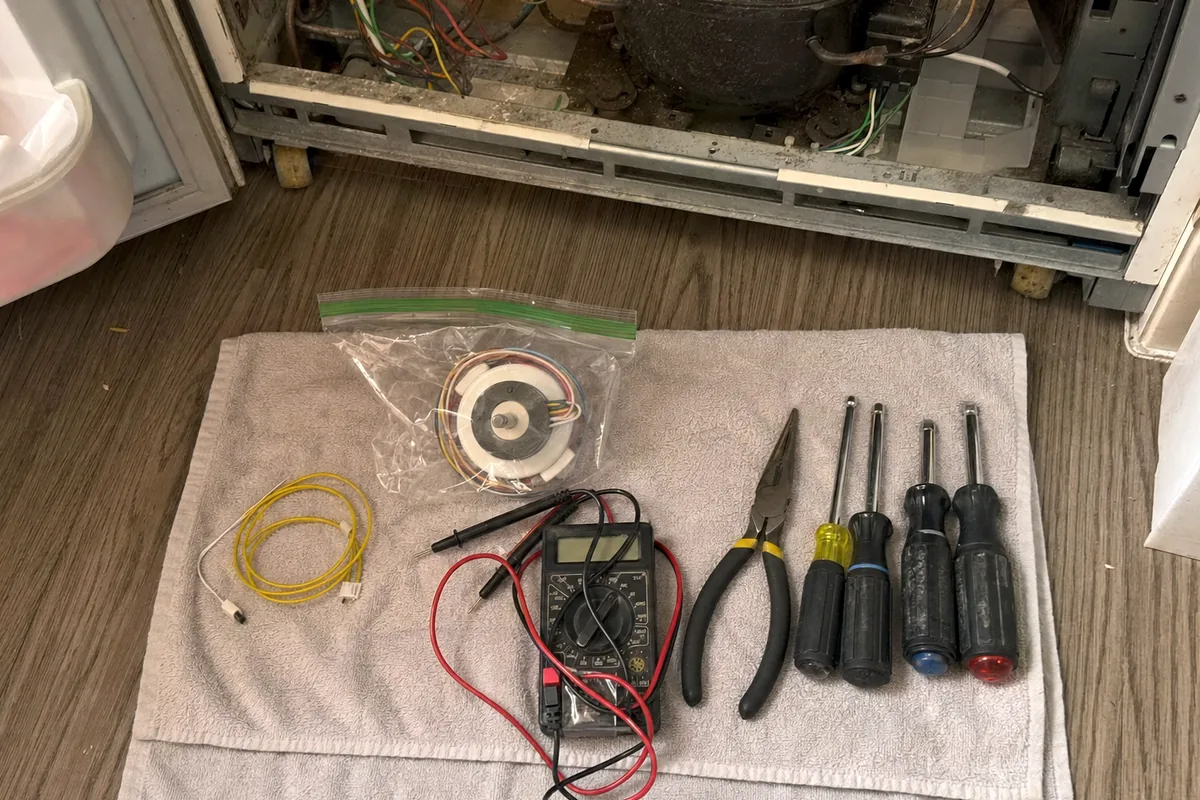
The refrigerant circuit is the part of the appliance an owner never sees: compressor, condenser, metering device, evaporator, and the tubing that joins them into a closed loop. When it is right, it is the most reliable thing in the kitchen. When it is wrong, it is the most expensive, and that is precisely why it should be the last conclusion reached rather than the first.
A surprising number of appliances we are asked to look at for “a bad compressor” have nothing wrong with the compressor at all.
What gets blamed and what is usually true
The three faults that most often masquerade as a dead sealed system are a blocked condenser, a stalled condenser fan, and a control fault that has left a component unpowered. All three produce the same headline complaint — the cabinet will not get cold — and all three are cheaper to correct by an order of magnitude.
That is why every visit begins with measurement rather than replacement. Run time across a full cycle. Air temperature in and out of the condenser. Frost pattern across the evaporator. The frost pattern in particular is worth its weight: an evaporator that ices for the first third of its length and stays bare after it is telling you about a restriction or a shortage of charge, in a way that no amount of listening to the compressor will.
When it genuinely is the sealed system
There are three broad cases.
A leak. Refrigerant does not get used up. If there is less of it than there was, it went somewhere, and finding where matters more than adding more. A system topped up without the leak being found is a repair with an expiry date on it, and we will not sell one.
A restriction. Moisture or debris in the circuit narrows the metering point, the evaporator starves, and the cabinet cools partially. This is the fault that most reliably produces the half-frosted evaporator described above.
A compressor that will not start against pressure. It hums, it draws current, it trips its overload, it tries again a few minutes later. Sometimes this is the compressor. Often enough it is the start component feeding it, and that distinction is a large difference on an invoice.
Two systems means two answers
Dual refrigeration — a separate sealed system for the fresh food compartment and another for the freezer — changes the arithmetic of every one of these diagnoses. A cabinet with one system down is not half broken; it is one intact machine and one that needs work. It also removes the most common false conclusion, since a fault affecting only one compartment cannot be a supply problem, a door problem or a room problem. Those would affect both.
The credential this work requires
Sealed-system work involves recovering and handling refrigerant, which is regulated. It is carried out by EPA Section 608 certified technicians. That is the only credential we state anywhere on this site, we hold it, and we hold no appointment from the manufacturer of the appliances we service.
Storms, boards and the fault that looks like refrigeration
St. Johns County sees roughly sixty-eight thunderstorm days in a year. A surge that damages one output on a control board can leave a condenser fan idle while every other function of the appliance behaves normally. The cabinet warms, the compressor runs continuously, the grille gets hot, and the whole presentation is that of a failing sealed system. It is not. It is an electrical fault with a thermal signature, and the measurements above separate the two in about twenty minutes.
Booking
Flat $80 diagnostic, credited toward the repair on approval. Written estimate before any part is ordered. Genuine OEM parts. 90 days on labour and 365 days on parts. Weekdays 8:00 am to 6:00 pm, Saturday 9:00 am to 4:00 pm. Sub-Zero refrigeration only.