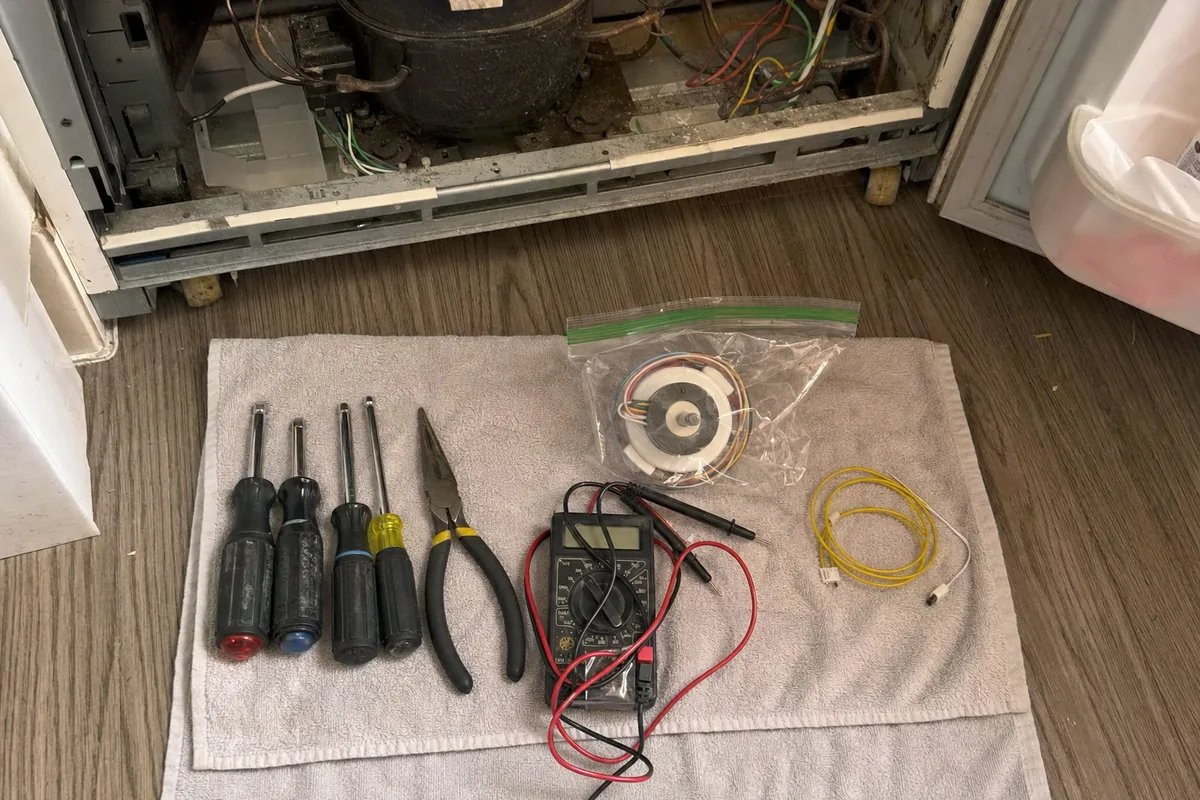
A built-in refrigerator does not usually fail on a Tuesday for no reason. It declines, quietly, over a period long enough that the household adjusts to it without noticing — a slightly softer ice cube, a compressor that no longer cycles off at night, a grille that is warm to the back of the hand when it used to be cool.
Nearly all of that shows up at the condenser.
The three things worth looking at
Airflow. A built-in rejects its heat through a grille, not into the room at large. Anything that narrows that path — a cabinet valance fitted later, a run of dust in the fins, a basket stored on top of the unit — raises head pressure. The compressor answers by running longer. Nothing about that is dramatic on the day it starts, which is exactly why it goes unremarked for years.
Fin condition. Aluminium fins in a coastal ZIP code do not stay bright. Salt air reaches 32084 and 32082, and the film it leaves both insulates the fin and starts the slow corrosion that eventually closes the gaps between them. A fin pack you cannot see light through is not a maintenance item any more; it is a compressor with a shortened life.
Run time. The most useful measurement in the whole cabinet costs nothing: how much of the hour does the compressor actually run? A unit that used to cycle and now runs continuously has told you something is wrong well before the food warms up. It does not tell you what — but it converts a vague worry into a number you can repeat to us on the telephone.
How to take the reading yourself
Stand near the appliance for five minutes at a quiet time of the evening, when nobody has been opening the door. Note whether the compressor stops at all. Then do the same thing a week later. Two observations a week apart are worth more than one anxious hour, because what matters is the direction of travel.
If the cabinet used to fall silent and no longer does, and nothing about the household has changed — no new ice consumption, no door left ajar, no unusual heat in the room — then the condenser is the first place to look.
Why this matters more here
Two local conditions push in the same direction.
Salt air on the coastal ZIP codes attacks the fins and the hinges. The 32080 barrier island houses take it hardest, and the marina air at Camachee Island in 32084 is not far behind. We routinely see the same model, in the same year, in noticeably better condition eight miles inland at Murabella or in the King & Bear.
And roughly sixty-eight thunderstorm days a year mean the control boards in these houses take more surges than boards in a drier climate. A board that survives a strike but loses one output can leave a condenser fan idle while everything else looks completely normal. The grille gets hot, the compressor never stops, and the presentation is indistinguishable from a refrigeration fault until somebody puts a meter on it.
What to do about it
Pull the grille twice a year and look. If the fins are grey rather than bright, or if you cannot see light through them, the unit is working harder than it was designed to. On the island, twice a year is the minimum rather than the target.
That is a maintenance visit, not a repair, and it is a great deal cheaper than the compressor it protects.